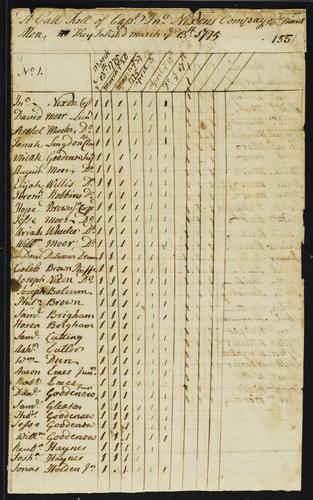
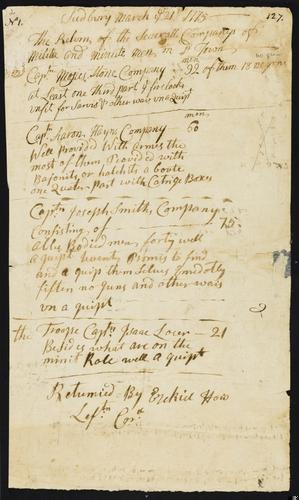
Full Page of How's Return
We actually know very little of what actually transpired for the militia of Sudbury on the 19th. We know that the Sudbury companies marching on the west side of the Sudbury River were met near the South bridge of Concord and directed to go around to the north. We have Ezekiel Howe's quote “If any blood has been shed, not one of the rascals shall escape.” We know the East Militia attacked at Hardy's Hill.
Most certainly we know that Deacon Haynes and Asahel Reed gave their last full measure of devotion on April 19th, 1775.
From:Massachusetts_Soldiers_Killed_April_19,_1775.
| Asahel Reed | age 22 | Killed near Hartwell's Tavern, Lincoln (probably) |
| Josiah Haynes | age 80 | Killed at Concord Hill, which is indicated as being in Lexington in the articles below. |
From Merriam's bigraphy of Nixon, (see more below) and Nixon's minute men arrived there early and found the bridge held by British. His men were eager to attack but orders the had been received from Colonel Barrett to halt and in no case to begin the fight. Old Deacon Haynes, nearly eighty years old, said to his captain, "If you don't go and drive them British from that bridge, I shall call you a coward," but Nixon replied, "I should rather be called a coward by you, than called to account by superior officers for disobedience of orders. We are reference to this incident Bancroft refers to the Sudbury captain "as the brave Nixon." His control over his impatient men, with the taunt of cowardice thrown in his face, is evidence of a superior order of bravery. In the pursuit of the British to Cambridge the Sudbury men were foremost and the old deacon was among the killed.
Hudson Shattuck says, “ Two companies from Sudbury under How , Nixon and Haynes came to Concord, and having received orders from a person stationed at the entrance of the town,for the purpose of a guide, to proceed to the North instead of the South Bridge, arrived near Col. Barrett's just before the British soldiers retreated.” The same author, after speaking of what we have just narrated of Lieutenant Colonel How, states, “ Before proceeding far, the firing began at the Bridge, and the Sudbury companies pursued the retreating British.” From these statements and facts, we may infer this,– that these companies passed the British at Colonel Barrett's and pushed on to meet the force at the bridge, that before they joined it the foe made his attack andthattheyjoinedinthehotpursuit. Thistheoryaccords with the statement that we have quoted before, as made by a survivor of the fight,which is that “ Sudbury Companies were but a short distance from the North Bridge when the first Opposition was made to the Haughty Enemy.”
From: Sudbury at Concord and Lexington: The North Militia and Minute Company, as we have stated, designed to reach Concord village by way of the old South Bridge, but when about half a mile from it were ordered to proceed to the north bridge by Colonel James Barrett, the commander of the minute regiment, whose son Stephen had been sent to convey the message to the approaching companies. By obeying this order, the Sudbury companies would join a force already assembled on the north side of the village, and also avoid speedy contact with the British guard that already held the South Bridge.
From boston1775.blog According to Lemuel Shattuck’s 1835 history of Concord, the two companies “received orders from a person stationed at the entrance of the town for the purpose of a guide, to proceed to the north instead of the south bridge.” That Concord man was later identified as Stephen Barrett (1750-1824), son of Col. James Barrett, commander of a Middlesex County militia regiment.
Hudson: In accordance with Colonel Barrett's command,Captains Nixon and Haynes with Lieut.Col. Ezekiel How started,as we have stated,for the old north bridge. When at the South bridge they were on the westerly side of Concord village, while the North bridge was a little to the northofeast. Their way, therefore, was by something of a circuitous course ; and, to reach the point to which they were ordered,they were to pass the house of Colonel Barrett, a mile and a half north-west of the village,where Captain Parsons with three British companies were destroying Continental stores. When the Sudbury soldiers came within sightofColonelBarrett'shousetheycame toahalt. Before them were the British engaged in their mischievous work. Gun carriages had been collected and piled together tobe burned, the torch already had been applied, and the residence of their Colonel had been ransacked. They halted, and Colonel How exclaimed,“ Ifany blood has been shed not one of the rascals shall escape!” and,disguising him self,he rode on to ascertain the truth. It was,probably, not far from nine o'clock when this event took place. This indicates the celerity with which the Sudbury troops had moved.
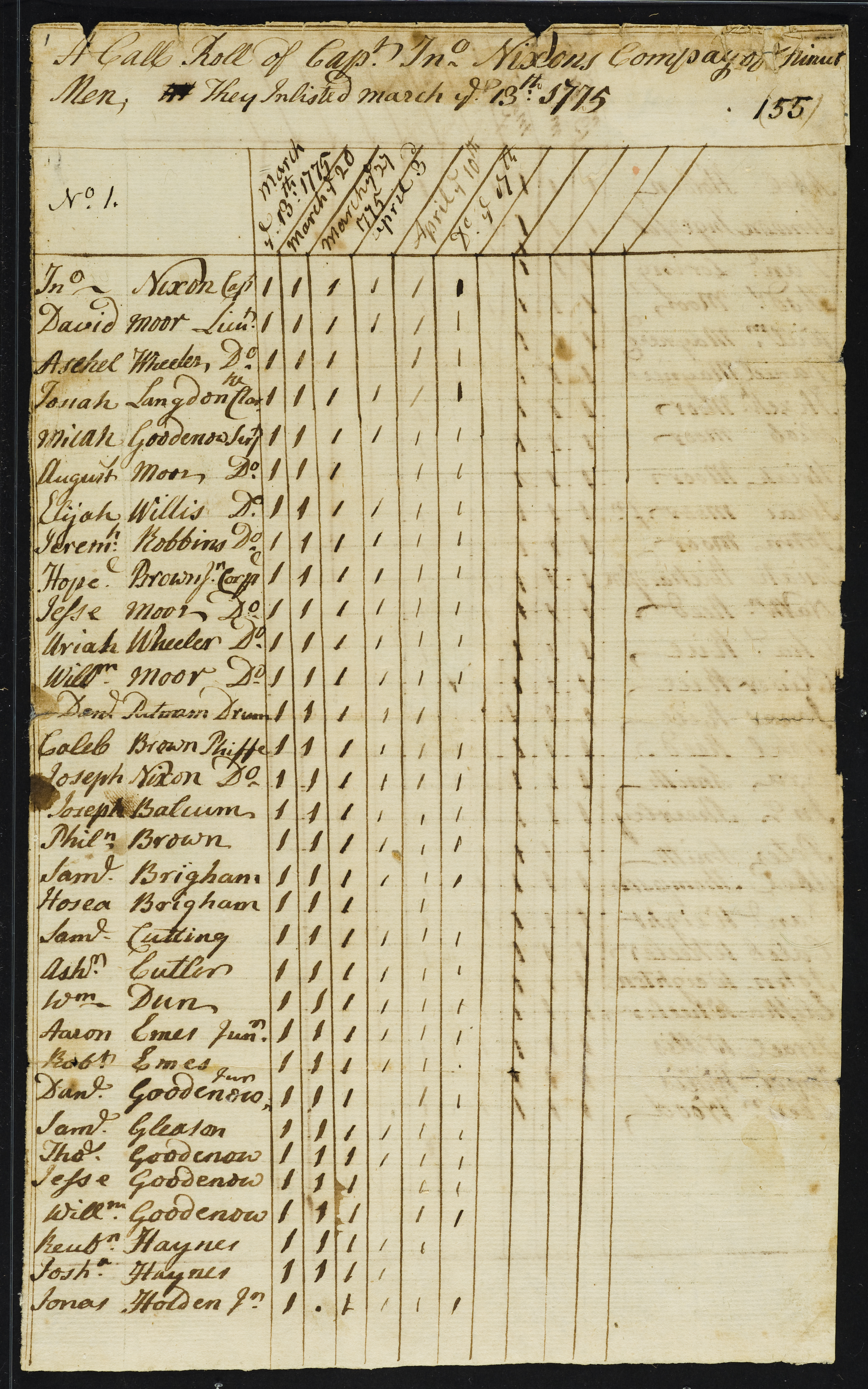
Hudson: During the day Sudbury sustained the loss of two men. Deacon Josiah Haynes and Asahel Reed. Joshua Haynes was wounded. Deacon Haynes was eighty years old. He was killed by a musket bullet at Lexington. He belonged to the old Haynes family of Sudbury, where his descendants still live. He was one of the original signers of the West Precinct Church Covenant, and was made deacon May 24, 1733. He was buried in the Old Burying Ground, Sudbury Centre. The grave is marked by a simple slate stone. Mr. Asahel Reed was of Captain Nixon's minute men. His name is found on that company's call roll to which we have before referred ; it is left out after the battle, probably because after his death the name was stricken from the list. He belonged to the old Reed family of Sudbury, whose progenitor, Joseph Reed, settled at Lanhara about 1656.
With the approach of the Revolution he organized a large company of minute men from Sudbury, of which he was captain, and he led this company to Concord early on the 19th of April, 1775. In the accounts that day most of the attention has been given to of what took place at the North bridge, and but little attention given to the South bridge. This was in the line of approach from Sudbury, and Nixon's minute men arrived there early and found the bridge held by British. His men were eager to attack but orders the had been received from Colonel Barrett to halt and in no case to begin the fight. Old Deacon Haynes, nearly eighty years old, said to his captain, "If you don't go and drive them British from that bridge, I shall call you a coward," but Nixon replied, "I should rather be called a coward by you, than called to account by superior officers for disobedience of orders. We are reference to this incident Bancroft refers to the Sudbury captain "as the brave Nixon." His control over his impatient men, with the taunt of cowardice thrown in his face, is evidence of a superior order of bravery. In the pursuit of the British to Cambridge the Sudbury men were foremost and the old deacon was among the killed.THE MILITARY RECORD OF BRIGADIER GENERAL JOHN NIXON BY JOHN M. MERRIAM REPRINTED FROM THE PROCEEDINGS OF THE AMERICAN ANTIQUARIAN SOCIETY FOR APRIL, 1926
Middlesex County minute men arriving in Cambridge remained there under arms almost to a man and on the 24th of April commissions were issued and enlistments sought for definite service. John Nixon was commissioned Colonel by Massachusetts April 24, and a regiment was organized under his command...
Captain John Nixon was a veteran of the French an Indian War. Soon after the battles of Lexington and Concord he was promoted to colonel and led the Sudbury militia at the battle of Bunker Hill. In August 1776, Nixon was promoted to brigadier general. The next year, a cannonball passed so close to his head that his sight and hearing were affected the rest of his life.
Captain Nixon lived on Nobscot Hill and is where he started on the morning of April 19th. The cellar hole of the house can still be found just off Nixon road in the Nobscot Scout Reservation. The [Nixon School] is named for him. You can read more about Nixon on [WikiPedia] and much more about his military record [here].
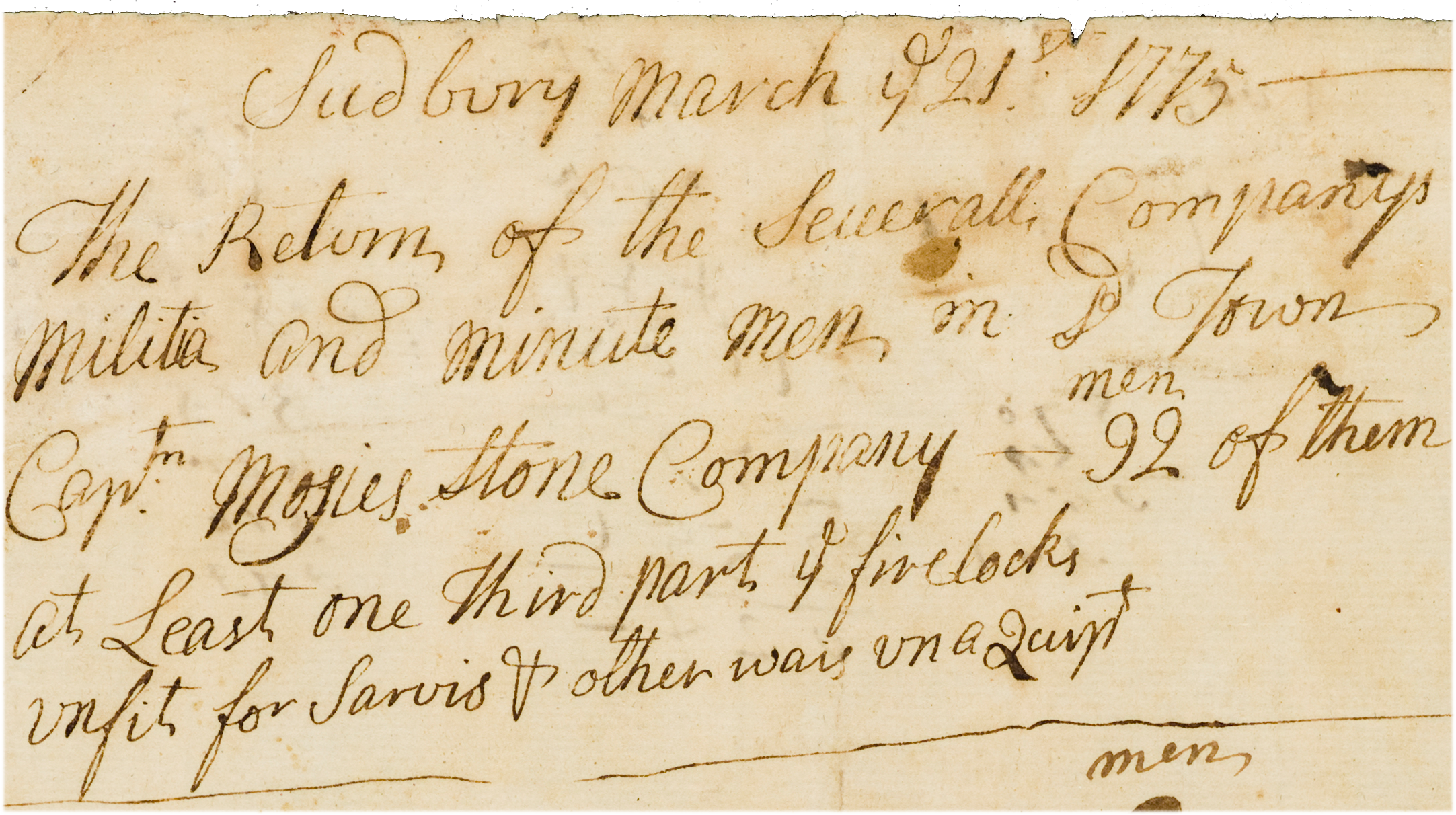
250 years ago, on March 21, 1775, Ezekiel How(e) reported on the status of the militia companies. Here is how his "return" begins:
Full Page of How's Return
Here is a transcript from Hudson's History of Sudbury, page 370 [https://sudbury.minlib.net/Record/.b11962549]
The Return of the Severall Companys of Militia and Minute in sd TownOn April 19th, Lieutenant Colonel Ezekiel Howe would be second in command to Colonel James Barrett of Concord. We will have more on Ezekial in April.
viz. Capt. Moses Stone's Company 92 men of them, 18 no guns, at Least one third part of five locks unfit for Sarvis others wais un a quipt.
Capt. Aaron Hayns Company 60 men well provided With Arms the most of them Provided with Bayonets or hatchits a boute one quarter Part with Catrige Boxes.
Capt. Joseph Smith's Company consisting of 75 able Bodied men forty well a quipt twenty Promis to find and a quip themselves Emedetly fifteen no guns and other wais un a quipt
The Troop Capt. Isaac Locer (Loker) 21 Besides what are on the minit Role well a quipt.
Returned by Ezekiel How. Lef: Con:
How's Return How's Return
North Militia Company, West Side — Captain Aaron Haynes, 60 men.
East Militia Company, East Side — Captain Joseph Smith, 75 men.
South Militia Company (Lanham District) both Sides — Captain Moses Stone, 92 men.
Troop of Horse, Both Sides — Captain Isaac Loker, 21 men.
Minute Company, West Side — Captain John Nixon, 58 men
Minute Company, East Side — Captain Nathaniel Cudworth, 40 men
These make, besides the alarm list of Jabez Puffer, six companies
— three hundred and forty-eight men.
Notes: 1) When Hudson uses the name Lanham District on both Sides, he is not talking about both sides of the Sudbury River, he is saying that the Lanham District spanned both towns. Consider both Sides of Landam Road. There is a lot of Wayland on the west side of the rivier. See Map Of Sudbury 1776
2) On Minute Companies, from What is a Minuteman?
Generally, minute companies were comprised of young citizen-soldiers, 30 years of age or younger, who were quick, agile, and kept ready for deployment “in a minute’s notice.” Like most militia forces, they were armed and equipped at their own expense...While all minutemen were part of the militia, not all militia troops were minutemen.
3) Note on Alarm lists, as in the list Jabez Puffer maintained.
See Also: The National Parks Service Militia page as it relates to Battle Road Park, which includes an informative video.
They marched off from the West Side Meetinghouse, which server as both the church and the town hall.
On April 19th, Lieutenant Colonel Ezekiel Howe would second in command to Colonel James Barrett of Concord. On May 10th, 1776, he was commisioned as Colonel of the Fourth Regiment of Militia in the County of Middlesex.
Nice articles: Howe on April 19th and The Innkeeper
In 1760, he was commisioned at the First Lieutenant of Sudbury. On March 27th, 1781, he was appointed Justice of the Peace, with Governor John Hancocks signature! Scans of Ezekiel How's Commisions
Ezekiel Howe was a member of the Sudbury Committee Of Correspondence and he signed the The Sudbury Tea Party Resolves.
Tony Howes, no relation, will be giving a talk on Ezekiel as part of the Sudbury 250 Celebratons.
Ezekiel Howe is discussed in the new book _Enslavement in the Puritan Village_, by Jane Sciacca.
https://jch.com/archives/SudburyTown/Miscellaneous_17thC_19thC/idxThumbs.html
Ezekiel spelled his name How, but family and history have regularized it to be Howe.
More than an innkeeper, Ezekiel How played a significant role in Sudbury before and during the American Revolution. He joined the Sudbury militia at age 16 in 1736, as was customary for able bodied men between the ages of 16 and 60. Over the years, he rose in rank, becoming a Lieutenant in 1760, a Lieutenant Colonel in 1774, and finally a Colonel in 1776. Beyond his military service, he actively contributed to the Sudbury community by surveying highways and participating in town meetings.
Ezekiel How''s contributions to American independence extended beyond battlefield leadership. He secured supplies for soldiers, managed resources, and organized troops. In 1779, he resigned as Colonel of the Sudbury Companies of Militia and Minute due to ill health. Despite his resignation, he continued to serve Sudbury and the broader community, including overseeing enlistment efforts during the war.
In 1774, Ezekiel How bought arms. It was approved in a towm meeting. He was reimbursed in October
When they were given the orders, Deacon Haynes taunted Nixon. "If you don't go and drive them British from that bridge, I shall call you a coward," but Nixon replied, "I should rather be called a coward by you, than called to account by superior officers for disobedience of orders." Deacon Haynes was 80 years old. He would perish later that day.
What if Nixon had not been as disciplined and the rest of the men were as eager as Haynes. They might have engaged the British at the South Bridge. They numbered at least 100 and would have taken the bridge and headed into the town center of Concord. Sudbury would have had the glory of starting the Battle of Concord, but the town would have been severely damaged. It seems a small price to pay.
What if Sudbury fired the first shot?
On April 19th, 1775, the West Side Minutemen of Sudbury, led by Captain Nixon, were met by Col. Barrett's son before they got to the South Bridge of Concord. Col. Barrett instructed them to go around the to the west to see at Barrett's farm to the north of Concord. This meant an extra 5 miles of marching with their muskets, powder, ammunition, water, blanket, and ideally a bit of food to sustain them for the day. That is why they were not recorded as being present at the first fighting at the North Bridge. They were close enough to hear the first shots, but we have no records of when they joined the fight.
2025-04-18 jch.com/history/250/April19th.html YON - Jan C. Hardenbergh